Sunday, November 2, 2014

1629 - the Massachusetts Bay Company

John Endecott orders the felling of the Maypole
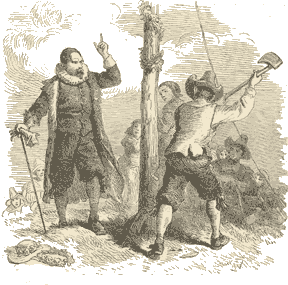
Winter, 1629 - As starvation rages in Salem, Governor John Endecott and the settlers go to Merrymount, (renamed Mount Dagon) and destroy what remains of the "Maypole" raised by Thomas Morton.

The Merrymount colony had continued despite Thomas Morton’s ouster and its people had raked in for winter a plentiful corn crop. Starved, the settlers of Salem had come to grab a part of it and cut down the famous Maypole that they compared with the Calf of Horeb and a heathen idol. Thomas Morton had returned shortly after to Merrymount to discover that there was no one left. He was arrested again and banished from the colonies without legal trial.

January 13, 1629 - the Plymouth colony gets an exclusive agreement called Warwick Patent (or Kennebec Patent) on the Cushnoc trading post (now Augusta, ME) founded the year before on the banks of the Kennebec River.

On Edward Winslow's instigation, contacts had been made from 1625 between envoy of the colony John Howland and the Abenaki Indians who lived in the area. Barter agreements had been concluded allowing the English to get beaver pelts in exchange for corn. Fur sale being very attractive on English markets, the government of Plymouth had endeavoured a patent to secure a monopoly on all pelts from the Kennebec. Despite its resources, the colony remained very indebted to its investors and interest payments being outrageous, trading fur was for it an essential financial contribution.
John Howland had been chosen to head Cushnoc post and had with his men built a warehouse along the Kennebec River to store corn and bartering goods such as clothing, blankets, biscuits, peas, prunes, etc. …

March 1629 - William Bradford is re-elected governor of the Plymouth colony for the 8th time.

March 4, 1629 - With support from Robert Rich, 2nd Earl of Warwick, the Massachusetts Bay Company is  granted a royal charter allowing it to take over the operations of the Dorchester Company two years after it went bankrupt.

March 5, 1629 - Doctor John Pott is elected governor of Virginia by the council instead of captain Francis West left for England.

John Pott was a controversial character. He had especially prepared the fatal drink having poisoned more than two hundred Indians during a meeting with the settlers on May 22, 1623. He was sentenced for this but had also resolved as a doctor many of health problems related to poor living conditions by practicing an innovative medicine which would gain widespread acceptance. 
As governor, he would especially focus on the interests of the colony against the Indian threats. He decided to mount all four months attacks against the nearby tribes and created for that purpose a militia that was soon blamed for the crudeness of its methods. He also decided to limit the amount of tobacco to be planted per individual. Poet George Sandys described him as a pitiful councillor.
The Lion's Whelp

April 17, 1629 - Governor John Endecott confirms in a letter territories between Charles River and Abousette River sold to John Oldham by Robert Gorges, holder since a charter of December, 1622 of territories located on the north-east side of Massachusetts Bay.

April 25, 1629 - The Lion's Whelp captained by Master John Gibbs leaves Gravesend with 5 other ships bound for the Massachusetts Bay colony.

Built in 1628 by George Villiers, 1st Duke of Buckingham, the Lion's Whelp was a 120-ton war pinnace armed with 8 cannons. 10 other ships of the same model were launched in few months in order to  create a fleet of privateers intended to increase the already untellable wealth of Buckingham.
The other ships of the fleet were the George, the Bonaventure, the Talbot, the Lyon and the Mayflower (not the Pilgrims' one).

Spring, 1629 - Reverend Ralph Smith arrives at Plymouth where he has been chosen as second Minister of the colony.
Agent in London of the Plymouth Pilgrim Fathers Isaac Allerton arrives from England, bringing with him Thomas Morton, expelled from the colony the year before.

Thomas Morton, whom Puritans called Lord of Misrule had spent a few months on the Isles of Shoals off the Massachustts Bay where he had been exiled by the Plymouth government before a ship takes him to England. In April, 1629, he was back in America as secretary of Isaac Allerton. He returned shortly after to Merrymount but conflicted soon with John Endecott, governor of Salem, about the rights of independent merchants, the Massachusetts Bay Company officials believing to hold control over all trade in its territory.
Ralph Smith had apparently no profile that suited the Separatists and was initially asked  to live outside Plymouth for fear of causing divisions. The governor and his assistants however had to resolve to accept the Minister moved to Plymouth by duty to protect his family.

May, 1629 - Chief Sagamore John reveals the English that the Narragansetts plan to attack them.

They had actually planned a military action against Plymouth.

May 24, 1629 - Virginia adopts the first American law regarding hunting and fishing regulation.

June 1, 1629 - 
brothers Edmund and Francis Ingalls, farmers hailing from Lincolnshire, are the first English colonists to settle in Lynn, former residence of Pawtucket Sachem Nanapashemet killed in 1619 by Tarratines.
 

June 7, 1629 - The Dutch West India Company enacts the Charter of Freedoms and Exemptions to spur new volunteers to settle down in New Netherland. It offers more lands to all the patroons who will make come at least, 50 new colonists.
Patroons (from the Dutch patroon, the owner) were the first landowners to get many territorial rights according to the new Charter intended to encourage immigration in America. They were granted privileges identical to those of feudal period allowing them in particular to establish civil and criminal courts and to have their own administration. They had in exchange to ensure the coming of at least 50 families in the four following years. These were exempted from taxes for ten years but had to pay the patroon in cash or services. 

June 29, 1629 - 200 new colonists arrive at Salem, in addition to the hundred already settled since the previous year.

July 4, 1629 - The Lion's Whelp reaches New England carrying a hundred would-be settlers sent by the Massachusetts Bay Company, including in particular Thomas Graves, Increase Nowell, Reverend Francis Bright and brothers Ralph, Richard and William Sprague. They settle at Charlestown.

Increase Nowell (1590 - 1655) - Born in Sheldon, Warwickshire, his name appears in the original charter of the Massachusetts Bay Company. He was a founding partner of the Charlestown colony (now a neighborhood of Boston) and the oldest minister of its first church.

William Sprague (October 26, 1609-October 6, 1675) – Born in Upwey, Dorset, he went to New England with his brothers and a hundred would-be settlers aboard the Lyon's Whelp. He was one of the founders of Charlestown.

July 8, 1629 - The colony of New England celebrates its first Thanksgiving Day.

August, 1629 - a group of 35 colonists arrives at Plymouth from Leyden in Holland. Several followers belonging to the church of minister John Lothrop are on board.

August 26, 1629 - According to the Cambridge Agreement, 12 shareholders of the Massachusetts Bay Company get the transfer in their favor of all powers on the New England colony. The members of the Company include Thomas Dudley, Isaac Johnson, Sir Richard Saltonstall and the lawyer John Winthrop who is appointed governor.

John Winthrop
John Winthrop (January 12, 1588 - March 26, 1649) - Born in Suffolk, he attended Trinity College in Cambridge before becoming lawyer in London. He was highly religious and had acceded to Puritanism considering that the Church of England should escape any catholic ritual. Winthrop was convinced that God would punish England for its heresy and believed that the Puritans needed a land where they would be safe when would come the time of His wrath. Other Puritans who thought like him got from the king a charter for the Massachusetts Bay Company. Charles 1 did not apparently imagine that the colony could be something else than a business establishment.

Thomas Dudley (October 12, 1576 - July, 1653) - Born in Northampton, he lost his father killed at the Battle of Ivry when he was 14 years old. He subscribed to Puritanism during the 1590s and entered the service of rich men as the Earl of Lincoln of whom he was an effective financial adviser. While tensions were high between Puritans and the English government, Dudley was chosen as one of the five officers leaving for America.

Isaac Johnson - Born in Clipham, Rutlandshire, he was a major shareholder of the Massachusetts Bay Company.

Late September, 1629 - Lord Baltimore arrives at Jamestown. Known to be violently opposed to catholicism, the Virginia settlers suspect him to want to move in their lands and reserve him a cold welcome before ordering him to leave the colony. 
George Calvert, 1st Baron Baltimore

Baltimore sailed back to England a few weeks later, well decided to get a new charter from the king.

George Calvert, 1st Baron Baltimore (1580- April 15, 1632) - He achieved a brilliant career as Member of Parliament and Secretary of State of King James 1 although he lost much of his political power after the failure of his wedding project between prince Charles and the Spanish royal family. He kept however his place in the King Privy Council until he publicly declared Catholic. Having to give up his duties, he was however upgraded 1st Baron Baltimore in the Irish peerage.
Calvert never hid his interest for colonizing the New World, first for commercial reasons, but also in order to create a haven for English Catholics. He thus became the owner of Avalon, the first English settllement in Newfoundland. Discouraged however by its harsh climate, he sought a place further south and strived to get a charter allowing him to settle in the region which was going to become Maryland. He died a few weeks only before he is granted.
Born in North Yorkshire, Calvert belonged to the landed gentry remained faithful to the catholic tradition despite the new rules imposed by Queen Elizabeth's government. He agreed in his youth to conform to the Allegiance Act required by the Church of England and could, in this way, study in Trinity College, Oxford. His knowledge of foreign languages allowed him to enter the service of Sir Robert Cecil and to accompany his ascent under James 1. He achieved various missions on the continent before being in the service of Robert Carr and becoming himself Secretary of State in 1619. He was then involved in the marriage of Prince Charles with the Hapsburgs but was increasingly regarded with suspicion due to his close relations with the Spanish ambassador and put into minority at the Parliament.
Calvert was nevertheless rewarded by King James who granted him the County of Longford. Increasingly isolated, he had to aknowledge that his proposed union with Spain resulted in a disaster. In 1624, he admitted his failure and only kept his place at the Privy Council. This was the moment he chose to announce to everyone's surprise that he had converted to Catholicism. Some felt afterwards that he had always been catholic but had conveniently hidden it.
In 1625, repression befell again the Catholics and Calvert had to resign the Privy Council. He decided then to leave for Avalon and sent out late May Sir Arthur Aston, promoted governor of the colony. He personally went only two years later to Newfoundland where he landed on July 23, 1627. He stayed there two months, the time to prove that this region had nothing common with the announced paradise. He returned the following year with his family and the title of Proprietary Governor but spent most time to fight against French ships. He tried vainly to hold togeteher Catholics and Protestants whereas the rigors of winter brought their fate of despair, combining cold and hunger. Baltimore petitioned the king a new charter to found a colony in a less hostile place and intended to settle in Virginia where he could grow tobacco. King Charles asked him to return to England with the honors but when his mail reached Newfoundland, Baltimore had already left to Virginia with his wife and servants.


Sir Robert Heath
October 30, 1629 - King Charles 1 grants his Minister of Justice, Sir Robert Heath (1575-1649) a territory located between 31th and the 36th degrees N latitude. This area called Carolana (now Carolinas) stretches from Florida to Virginia. Heath becomes the only owner of a huge strip of land supposed to go from the Atlantic Ocean to the Pacific. The patent describes him as led by the pious and praiseworthy desire to extend the Christian religion and the limits of the kingdom to develop trade. The king also rewards him at the same time with all Bahamas Islands.

The patent also contained the so-called Bishop of Durham Clause which granted to Heath wide feudal powers similar to those held by the prelate of the County Palatine of Durham, on the border with Scotland, and who had the right in particular to raise an army to protect the frontier in case of invasion. He could also, in his new territory, grant favors, pardons and honors.

Without never going there, Sir Robert Heath already knew somewhat the area to have been a member of the council of the Virginia Company and owned lands in the colony where he maintained farmers. During summer, 1624, at the time of the dissolution of the charter granted to the company, Heath had helped in particular King James in his efforts to impose a royal monopoly on tobacco trade, a project that never went through.

November 7, 1629 - Captain John Mason and Sir Ferdinando Gorges are confirmed in their rights on the lands between the Kennebec and Piscataqua Rivers granted since 1622. They form the Lyconia Company to base a farming community along the Piscataqua.
John Mason is assigned the area between the Piscataqua and the Merrymack to which he gives the name of New Hampshire and Sir Ferdinando Gorges the territory lying North of the Piscataqua which will become Maine.

The Merrimac valley was a part of the Pennacook territory whose Chief Passaconnaway (died in 1669) had just concluded a treaty of good neighborhood with the Plymouth colony.
Pennacooks - this Indian nation allied to the Sokoki and the Mahicans lived on the banks of the Merrimac and had its capital at Naumkeag (today Manchester, NH). It had particularly suffered from the Tarratine War that had bloodied the area between 1607 and 1615 and of which the Micmacs would emerge victorious, until epidemics came to decimate about 75 % of the local people. The Pennacooks began to maintain regular contacts with the English from 1621 and accepted their protection to get over the fear to see the Micmacs operate again their murderous raids. Their leader Passaconnaway agreed from 1629 to hand over  territories become deserted due to the steady population decline suffered by Indians, struck repeatedly by diseases carried by the Europeans against which they had no immunity.


Tuesday, October 28, 2014

1628 - John Endecott, Governor of Salem

March 1628 - William Bradford is re-elected governor of the Plymouth colony for the 7th time in a row.

March 10, 1628 - The first General Assembly of Virginia takes place in Jamestown with the consent of the king.

Although its representatives had met for the first time in 1619, the 1628 session was the first to be organized by the Crown after the dissolution of the Virginia Company of London in 1624. The concerns of the colony had been widely controlled by the directors of the Company and the first settlers had enjoyed the same rights and privileges as the English subjects but Virginia had unfortunately failed in developing as the king and investors would have wished.  In 1618, the leaders of the Virginia Company had authorized the creation of a colonial assembly with the hope that it would allow to tighten the links between London and the settlers and would contribute to open the way to the future. The first meeting was to debate hot topics for the colony as taxes, troubles with Indians and corn production.
By 1624, it had become however obvious that the Virginia Company would be unable to make the territory a populous and prosperous colony. After its dissolution, King James 1 transferred the responsibilities to a governor appointed by the Crown and his Privy Council. In March, 1628, King Charles asked governor Francis West to convene an assembly to discuss the contract under which tobacco produced in the colony would be exclusively sold in England.
Retaliatory measures were besides decided against Indians. 
Corn trade was now prohibited by the General assembly.  All the dwelling-houses should be strengthened against Indians assaults. The English would not have the right to venture nor to work alone and unarmed in their fields. Each corporation of the colony would have to attack the neighboring Indian tribes every July as it had become a tradition since the Great Massacre of 1622. Contacts between Indians and remote colonists were now banned and Indians no longer allowed to approach English villages, except for official missions.

April 7, 1628 - Johannes Michaelius, first minister of New Amsterdam arrives with his family in the colony.  Born in Dieppe, he is however fluent in Dutch. He celebrates his first service the same day in the new church of the Holy Spirit. The town has then 270 inhabitants.


May 1, 1628 - Rumor claims that the setting up of the Maypole by Thomas Morton at Merrymount ended in an orgy with Indian women.

Morton’s concept of religion was harshly condemned by the Plymouth Separitists who suspected him to be " indianized ". Rumors spread, alluding to depravity and licentious sex with Indian women in pagan revels where they honored Bacchus and Aphrodite. Morton had, in fact, implemented in the colony an old European custom that he had updated by combining classical mythology with his own loose trends and a certain zest for life. From a practical point of view, this party was designed to celebrate with the Indian tribes the fruit of hard work together and it was the opportunity for the settlers who were mostly men to find a bride among the native people. The anger of the Puritans was mainly fed by the report that Merrymount was achieving a certain prosperity by benefiting from the fallout of fur trade the Plymouth Plantation of which wanted to hold the monopoly. To help their cause, Puritans used to portray Morton as a led astray man attracting to him " the dregs of society ".

Myles Satndish at Merrymount
May 13, 1628 - Matthew Cradock is elected 1st governor of the Massachusetts Bay Company.

Following the failure of the Dorchester Company, this London-based organization aimed to revive the colonization of New England involving Puritan businessmen willing to invest in a large lasting settlement mainly devoted to tobacco production. Matthew Cradock was elected governor of the Company while staying in London whereas  John Endecott took the lead in the future colony.

June 9, 1628 -Thomas Morton is expelled from the Massachusetts colony after being accused of selling weapons and ammunitions to Indians.

Cutting-down  the Maypole

The Plymouth militia led by Myles Standish met only little resistance when it seized Merrymount. The Maypole was brought down and Morton arrested " to have supplied guns to Indians ". He was kept in Plymouth and, after a mock trial, deported to Shoals Islands off the coast of New Hampshire, until an English ship brings back him to England. Friendly Indians helped him.

June 9, 1628 - John Endecott sets sail from England aboard the Abigail heading up a group of 50 would-be settlers. He is one of the signatories to the chart granted to the New England Company by the Earl of Warwick authorizing the establishment of a plantation in the Massasuchetts territories, in a region located between the Merrimack and the Charles River, extending to the Pacific.

A learned man also speaking French, John Endecott had been chosen to lead this first expedition due to his military experience

September 6, 1628 - John Endecott arrives from England fronting of a group of 50 puritan settlers and moves to Salem, the new name given to the Naumkeag colony founded in 1626 by Roger Conant. He has a patent granted to the Massachusetts Bay Colony the first representative of which he is to land in America.

John Endecott (c. 1588 - March 15, 1665) magistrate, soldier and 1st governor of the Massachusetts Bay Colony. Nothing is known about him before his name appears in the six original patents of the New England Company. He was chosen by the directors of the Company to lead the first group of puritan colonists which settled at Salem. He occupied the post of governor of the colony until 1630.

The authority of Endecott was immediately put to the test. Winter 1628-29 was much harsher than the sweetness of the fall had foreshadowed. The newcomers had never experienced so cold winter in England. Added to severe weather conditions, disease began to wreak havoc. Faced with the problem, Endecott who had heard about the surprising results obtained by Dr Samuel Fuller who practiced in the Plymouth colony, asked Governor William Bradford permission to make him come to Salem.
Fuller's arrival tallied with the beginning of the transformation of Salem into a puritan colony. What was originally a settlement dedicated to trade and fishing turned gradually into an exemplary outpost of Puritanism. Fuller who had some charisma and a great power of persuasion was also deeply religious.

Samuel Fuller (1580-1633) - He had been part of the community of Separatists emigrated to Leyden in Holland before leaving for Plymouth in 1623. Governor William Bradford was related to his second wife. Three years earlier, his brother Edward Fuller had appeared among the Pilgrim Fathers of the colony. He had enough knowledge of medicine to the practice, as well as surgery. But he also served as deacon and his meetings with John Endecott about organizing the church of Plymouth influenced the founding of Salem. He had to die in 1633 during a smallpox epidemic.

September 12, 1628 - Charles 1 renews to the planters of Virginia lands and privileges previously granted to them by former King James. 
Virginia sends during this year about 35000 lbs of tobacco to England.

September 1628 - John Endicott sends the Sprague brothers, William, Ralph and Richard to explore and to take possession of the region around Salem.

The Sprague brothers were all three from Dorset, born in a landowners family. Ralph, the eldest one had been upgraded captain by new governor John Endecott and his brother Richard, lieutenant. They went up Charles River to the west reachingl a neck where lived an Indians' community called Aberginians. These showed themselves friendly and their leader Wonohaquaham, nicknamed Sagamore John suggested to settle on a nearby hill called Mishawum. The colonists called it Charlestown.

1628 - After four war years, the Mohawk defeat the Mahican forced to retreat beyond the left bank of the Hudson River. With this victory, the Mohawk conclude a trade alliance with the Dutch settled at Fort Orange (present-day Albany) which grants them a monopoly on pelt trade. The Indians are given in exchange guns and supplies from Europe.

The Dutch had been trapped by their own system, seeking to capitalize on the competition between both Indian nations. Being able to deal only with the Mohawk offered obviously fewer advantages, (especially as strenghtened by their power in the region, the latter also turned to the French) even though they could always count on their help to protect the colonists settled along the Hudson River against the attacks of neighboring Algonquian tribes.


1627 - The Maypole of Merrymount

January 13, 1627 - Council of Virginia decides to occupy the Chiskiak territory along the York River. This is primarily to dig into the Indian supremacy and insure the colony a refuge in case of Spanish assault.

The Chiskiaks had most probably already abandoned their territory, their last mention dating back to the spring, 1623, at the time of corn sowings.

"Plimoth Plantation"

March 1627 - William Bradford is reelected governor of the Plymouth colony for the 6th time.

He was a member of 8 contractors who insured the debt repayment of the colony to London investors. The risky management of their affaires by their agent in London Isaac Allerton, allowed to put an end to the regulation only in 1648.

April 1627 - Warned of an impending Indian attack, governor of Virginia Francis Wyatt takes further steps to protect the settlers.

The assembly ordered all the households to meet for prayer at least once a day and to provide a special worship place in every plantation. The settlers had no longer the right to waste powder by firing during celebrations and were not allowed to venture alone and unarmed. The military leaders were obliged to drill their men on every holiday. Many colonists however did not heed these constraints.

April 29, 1627 - Foundation of the Company of New France (or the Cent-Associés) by Cardinal Richelieu, including a hundred merchants and aristocrats determined to develop New France. It is a private company aiming to contribute to the  colonizing  efforts. It is granted a monopoly on fur trade throughout the North American continent from Florida to the Arctic.

May 22, 1627 - The government of Plymouth draws up the " Division of cattle ".
It is a complete list of the inhabitants of Plymouth (156) distributed in 12x13 people batches each assigned a cow or a calf and two goats. 

After buying their debt to the Plymouth Company, the settlers decided to share the cattle which consisted then of 22 goats and 17 cows. 

Revels at Merrymount
May, 1627 
-  Thomas Morton, leader of the disputed Merrymount (Ma-re Mount) colony raises a "Maypole" intended to mock the ascetic practices of the puritan Plymouth Plantation.


Located in the territory of present Quincy, called Pasonagessit by Indians, Thomas Morton who described himself as Lord of Misrule vowed to build a harmonious society mixed between Natives and settlers. It was a reason  for which he supplied firearms to the Indians in exchange for fur, promoting the idea that keeping with them friendly relation, these weapons will never be used otherwise than hunting. 
He was in stark contrast to the Separatists of Plymouth for whom he went to a pagan licenciousness. His settlement attracted all those who have had enough of the inflexible rules imposed by the Plymouth government. But setting up a Maypole, promoting revels to favor debauchery and drunkenness to wink at the Greek mythology, and fostering relationships between young Indian women Indian and bachelor settlers became unbearable in the Puritans eyes, making Merrymount, that they called Dagon Mount a den of Bacchanalians to be destroyed quickly.

July 4, 1627 - Governor George Yardley and the Council of Virginia decide, as they do regularly every year since 1623, to launch a series of attacks against Indians. They aim to take advantage of the summer to destroy crops. Men of various plantations are raised against the neighboring  tribes under the command of the officers of the colony.

Lt. Thomas Osborne had to attack Powhatans, Capt. Wiliam Pierce the Chickahominies, Capt. West the Tappahannas, Capt. Matthews the Warraskoyacks.

August, 1627 - in Virginia, the English settlers launch a series of attacks against the Powhatan tribes including Pamunkeys, Weyanocks, Chickahominies,               Quiyoughcohannocks, Warraskoyacks, Nansemonds and Chesapeakes.

These attacks did not however get the expected results. The Indians retaliated and made prisoners on the English side. 

Plymouth in 1627
October 1627
 - Ambassador Isaac de Rasieres arrives at Plymouth, appointed by the Dutch colony of New Netherland for a diplomatic and trade mission. It is he who introduces the use of wampum (sacred belt made of beads) as a bargaining chip with the Indian tribes.

He signed with governor William Bradford an agreement for the supply of Dutch goods in exchange for furs.

1627 - A second group of African slaves is landed at Fort Amsterdam (renamed New Amsterdam). It includes in particular three women whose Dorothy Creole who will not delay marrying Paulo of Angola, arrived two years ago.

New Amsterdam was then a muddy village with just about thirty houses and hardly 200 inhabitants. At that time, all the slaves belonged to the Dutch West India Company. Bringing women in the colony aimed to provide wives for men and to allocate inexpensive labor to the toughest chores. 

October 1627 - 
Dutch Governor Isaac De Razieres visits Apatucxet trading post established a few months before by the Plymouth settlers.

The place which was ruled by Caunacum, sachem of Manamet had been spotted from 1621 by the colonists of Plymouth for the fertility of its soils.

1627 - Sagamore John, the eldest son of Squaw Sachem who rules the Massachusetts tribes allows the English to settle in Charlestown (Mishawum) which is part of his territory.

Sagamore John (c. 1607 - 1633) real name Wonohaquaham, was the eldest son of the Massachusett leader Nanapashemit and his wife Squaw Sachem. He had two brothers, Mantowampate and Wenepykin who lived respectively at Saugus and Salem.

November 13, 1627 - Virginia Governor Sir George Yardley dies during his term. He is replaced by Sir Francis West.

To increase the number of settlers, the merchants of London, eager to recoup their investments in Virginia made kidnap about 1500 children, among whom some very young, who were sent without delay to the colony.

Francis West (October 28, 1586 - February, 1634) - Deputy governor of Virginia, he was the second son of Thomas West, 2nd Baron De La Warr (1556-1602) from Wherwell Abbey in Hampshire, and Anne Knollys his wife.
It is as captain that he landed for the first time in Jamestown in July, 1608. He returned in 1610 aboard the Mary and Margaret.
He was from 1608 a member of the Governor Council. From 1612 to 1617, he served as commander of Jamestown and was elected representative to be in session in the first Legislative Assembly which took place from July 30 to August 4, 1619, known as the first House of Burgesses appointed by Governor Sir George Yardley.
From 1622, West was promoted Admiral for New England, then Deputy Governor of Virginia from 1627 to 1629 and finally Captain General of Virginia.
He owned lands in Elizabeth City, south of James Knott's plantations.
He died in February, 1634. His older brother Thomas West, 3rd Baron De La Warr had been a governor of the Virginia Company in 1610 and 1611. He had also two younger brothers: John West (1590- c.1659) who was to be Governor of Virginia from 1635 to 1637 and Nathaniel West, Lt. Colonel of Virginia, dead in 1623 at the age of 30.

Thursday, October 16, 2014

1626 - Pieter Minuit buys Manhattan

Purchase of Manhattan Island
March 1626 - William Bradford is reelected governor of the Plymouth colony for the 5th time.

April 19, 1626 -  Governor of Virginia Sir George Yardley receives new instructions from England.
He has to send without delay a report on the colony with the census of plantations and settlers as well as an inventory of the properties that held the Virginia Company in 1623 and of what can be reserved for public use.

The newcomers should be welcomed and enjoy certain privileges. 
The people landing in the colony should be provided with a special authorization to prevent the entry of foreign enemies.
Drunkenness should be deleted. 
The settlers should be encouraged to plant corn rather than tobacco.
The planters are prohibited from receiving Indians home without special permission.

Spring, 1626 - Daniel van Crieckenbeeck, who commands Fort Orange on the banks of the Hudson Rivers is involved in the war between Mohawks and Mahicans. He joins a party of Mahican warriors with six of his men and dies in an ambush set by the Mohawks. 

These resented the Dutch who were supposed to remain neutral in this war for betraying them. Crieckenbeck's carelessness fortunately corresponded to the return of Pieter Minuit in the colony. He sent Peter Barentsz, a merchant who was familiar with the Indian language, to explain them that the commander of the fort had acted on his own and that such an incident would not repeat.
Minuit knew the country well and was aware that taking sides in wars between tribes could put in danger the small Dutch colony. 
The Mohawks were part of the six major Iroquois nations. They derived their name from the Mohawk River crossing their territory but they were called Kanienkehaka in Algonquian language which meant "Man-Eater"; the French meanwhile called them Agniers and the Dutch Maquas. 
The Mahicans lived in the upper Hudson valley. Their name meant "wolf" in Algonquian but the Dutch called them Indians of the River. They were about 16 000 in the early 17th century when the Europeans landed but this number had dropped to 1000 in 1672.

Spring, 1626 - Mount Wollaston - accused by Thomas Morton to have sold as slaves young people of their group, Henry Wollaston flees to Virginia with some of his supporters. Morton takes over the colony government that he renames "Merry Mount".

Thomas Morton ensued on an utopian experience declaring  all the settlers to be free men eager to integrate Algonquian culture. He aimed at civilizing the local Native American tribes by converting them to a form of liberal Christianity and supplying them free salt for preserving food and accordingly give up hunting in favour of a sedentary life. He began to write a diary the " Memories of New Canaan " in which he denounced the methods of the Puritans, according to him reproachable.
On the other hand, he considered himself as a " loyal subject " to the British Royalty.

Pieter Minuit
May 4, 1626 - Pieter Minuit, newly appointed Director General of New Netherland arrives at Fort Amsterdam.
He decides to dismantle Fort Wilhelmus, built two years earlier on an island of the Delaware, and to repatriate the families who settled there but chooses, on the other hand, to maintain a garrison in Fort Nassau located 35 miles upstream.

May 24, 1626 - Pieter Minuit buys for $24 worth of trade goods the island of Manhattan to the Wappinger tribe (or Canarsee, a sub-tribe linked to the Lenape) even though the northern part belongs to the Reckgawawanc.
New African slaves from Angola are landed in Fort Amsterdam.

Pieter Minuit (Wesel, Duchy of Kleve, 1580 - 1638) - 
Born in Tournai, his parents had fled to Rhineland to escape the Spanish religious persecutions which struck down the Protestants. 
He became famous by buying the island of Manhattan to the Indians in exchange for beads and other trinkets for 60-guilder equivalent (24$). As Director General of the colony of New Netherland, he was anxious to defend the interests of the settlers as the Indians' ones, under the principle that the harmonious integration of both cultures was better than rejection of the "less" civilized, bringing most often conflicts.

The Wappingers occupied in the early 17th century the eastern bank of the Hudson River between Dutchess County and Manhattan until the present-day Connecticut limit. They kept close relations with Lenape and Mahicans, two Algonquian speaking tribes.
According to the tradition, the alleged purchase price of Manhattan would have amounted to $24 but it has never been confirmed.

July 27, 1626 - Sailing from Holland, the Arms of Amsterdam (Wapen van Amtserdam), captained by Adriaen Joris Thienpont, arrives in New Amsterdam (Manhattan). Among the passengers can be found Isaack de Rasieres, the new secretary of the colonial government.

September 23, 1626 - the Arms of Amsterdam leaves Manahattan with a 7200 beaver pelts -cargo, as well as hundreds of wildcat, otter and mink skins.... It arrives in Amsterdam on November 4.

Autumn, 1626 - Roger Conant founds, with John Woodbury and Peter Palfry, a settlement at Naumkeag which will soon take the name of Salem.


Roger Conant
Roger Conant (East Budleigh, Devonshire April 9 1592- Salem 1679)
He first worked as apprentice in the London saltings. He immigrated to Plymouth in 1623 with his wife Sarah and his son Caleb, but soon found disagreed with the strictness of the puritan rules imposed in the colony. He left next year to settle at Nantasket where he met Thomas Morton and minister John Lyford.
He got noticed by John White, representative of the Dorchester Company who asked him to head his business in Cape Anne, what Conant agreed in autumn, 1625. Fishing and corn planting had not, so far, given the expected results and the idea to vacate the premises had been considered especially as the Dorchester Company was on the verge of bankruptcy. Conant himself found that Cape Anne (Gloucester) was mismatched and chose to transfer to Salem, located 16 miles to the south, with 40 settlers who lived there. He became the first governor of the new colony and John Lyford was appointed as the priest of the Anglican Church.

October 1626 - Governor Francis Wyatt and the Virginia Council order that all the dwellings would have to be paled before May 1, 1627.

As it has been suggested when met the House of Burgesses, plans were also made for running pale in the forest in order to ensure a better defense against the Indians.

November, 1626 - the Sparrowhawk, a small ship from England sailing to Virginia, wrecks on the coast of Cape Cod. All safe and sound, its 25 passengers are taken in by the people of Plymouth.

November 15, 1626 - The Pilgrim Fathers of Plymouth buy back their shares to the investors of London.


1625 - Building of Fort Amsterdam

January, 1625 - a census counts 1232 settlers in Virginia (952 males and 280 females). 31 are Africans.

January, 1625 - a 6-ship fleet is formed in the port of Amsterdam due to leave to the New Netherlands. This is the largest colonizing expedition never undertaken for the Dutch.
Left first, the 150-ton vessel Oranjeboom carrying new Director Willem Verhulst is however quickly seized by the English authorities which force the ship's company to stop at Plymouth.

These were surprised to see the ship's hold loaded with seeds, farming tools and various live plants but let it go in exchange for some promises while a plague spread among the passengers making its first dead.
The other ships were to leave later. Two vessels in particular, the Koe and the Swaerte Paert had been especially arranged for carrying livestock of which hundred horses, cows, hogs and sheep. The Mackereel and the 200-ton Schaep carried equipment and the would-be settlers.
The Ruijter left last, transporting mainly livestock. Chartered by a group of merchants including in particular Samuel Godijn and Kiliaen Van Rensselaer, this one followed the traditional route by the West Indies but was captured off the African coast by Moorish pirates. The crew and the cargo were lost but the investors succeeded to offset partly their losses through insurances. Despite this misfortune, the Ruijter experience had just proved that it was easy for private investors to challenge the monopoly of the Dutch West India Company.
Struck by bad luck, the Mackereel was in its turn soon seized by a pirate ship off the English coast.

March 1625 - William Bradford is reelected for the fourth time governor of the Plymouth Plantation.
King Charles 1 (portraited by Gerrit Van Honthorst)

March 27, 1625 - King of England James 1 dies at the age of 58. His son Charles 1 succeeds him, he is 24 years old.

The new king confirms Virginia status of Royal Colony granted the previous year following the failure of the London Company and maintains Sir Francis Wyatt in his governorship.
The governor is now appointed by the Crown, flanked by a Council and a House of representatives elected by the settlers. Basically, a parish council controls the finances, chooses the Ministers of religion and provides assistance. Judges and jury, elected by the parish councils meet in session in the capital of the county.
Virginia receives the Anglican Church but bends the episcopal system towards a moderate congregationalism. Its institutions will inspire the other colonies.

Late March, 1625 - After a forced stop in Plymouth, the Dutch ship Oranjeboom (Orange Tree) arrives insight of the American coast. Eleven passengers died during the voyage and twenty others fell ill until the boat leaves the English port, hit by a plague. New Director Willem Verhulst who is on board chooses to land the passengers on the banks of Delaware where is already a small colony.


Spring, 1625 - Captain Henry Wollaston leaves Plymouth to found a new settlement 25 miles to the north that he names Mount Wollaston (present-day Quincy). He is accompanied by Thomas Morton and a group of about thirty people being at loggerheads with the rules imposed by the government of the colony.

Thomas Morton (1576-1647)
Writer, lawyer and merchant hailing from Devonshire, an area that most Protestants did not like due to its hardline conservatism.
At the beginning of the century, Morton entered the service of Sir Ferdinando Gorges, then governor of the port of Plymouth and a partner of Sir Walter Raleigh very involved in the settlement of the New World.
In 1622, Morton sailed to explore the coast of New England but complained in his return about the intolerance prevailing in the Puritan community. He returned there in 1624 aboard the Unity during a mission partlly funded by the Crown with an associate, captain Henry Wollaston and thirty young people hired under contract. From their installation, they devoted to fur trade on a plot of land granted by the local Algonquian tribes of which Morton liked to say that they were much more civilized and human that their intolerant European neighbors. The Puritans of New England accused him of selling them guns and alcohol in exchange for furs and provisions, which, at that time, was illegal. There was nevertheless no doubt that weapons acquired by the Indians had to be used to defend themselves against the northern tribes, always on war footing, and not against the fearful settlers. The village laid out by both men quickly became a farming colony. Morton discovered however that Wollaston had not hesitated to sell as slaves to Virginia planters some of the young people under contract who had accompanied them. He urged those who remained to rebel and get organized in free community.


April 22, 1625 - the Dutch West India Company decrees the buiding of Fort Amsterdam and ten adjoining farms.

The Oranjeboom, chartered by the Dutch West India Company arrives at Manhattan, carrying 42 families of new settlers led by engineer Kryn Fredericksz. They found Fort Amsterdam in the southern tip of the island, what new governor Willem Verhulst considers an optimal choice for a lasting settlement. The first houses are built and some streets drawn next to the fort.
The Dutch had no intention to seize the place by force, preferring to negotiate with Indians purchasing in due form a piece of their land so as not to tarnish trade connections started for at least 10 years.
Construction began supervised by Willem Verhuslt who had replaced captain Cornelius Jacobsen Mey in the Direction of the New Netherland colony and his chief engineer Kryn Fredericksz. They were completed late 1626. At that time, Manhattan was still only a minor establishment because most of the Company's operations concerned the beaver pelts trade which was made throughout the Hudson River.
When the building site was completed, the Director grouped together in Manhattan the colonists settled along the Delaware and those landed the previous year at Fort Oranje, leaving to protect it a small 16-men garrison.

April 25, 1625 - The 4 ship-fleet including the Mackereel captained by Gerryt Fongersz (who carries "further instructions" to new governor Willem Verhuslt), the Swaerte Paert, the Koe and the Schaep leaves Texel setting sails to New Netherland. It carries 45 new settlers and 103 heads of cattle including horses and mares, Holstein bulls and cows, sheep and hogs.

The funding of the expedition had been provided at his risks by the Amsterdam brewer Pieter Eversten Hulst.

April 27, 1625 - the Hulst-fleet is attacked by pirates who seize the Mackereel. The three other ships follow their route. 

Fort Oranje, bithplace of Sarah Raplaje
June 6, 1625 - Sarah is the name given to the first baby born in the New Netherlands. She is the daughter of Joris Jansen Rapalje and Catayntje Trico. Her parents were among the first immigrants, arrived in the colony in March, 1624 aboard the Eendracht.

Sarah Rapalje (Fort Orange 1625 - New York 1685)
Her parents quickly left living to New Amsterdam where the activity was more prosperous. She was only fourteen when she married Hans Hansen Berger (? - 1654), a Norwegian emigrant from Bergen, arrived in the colony in 1633 who owned plantations near Brooklyn. She had 8 children with him and married, once a widow Teunis Gysbertsen Bogaert who gave her seven others. She died at 60 exhausted by her many pregnancies.

July 1625 - the Dutch fleet including the Koe, the Swaerte Paert and the Schaep reaches Governors Island with 45 new settlers and livestock.

Cattle was first penned up on Nutten Island (today Governors Island) but lack of water and grazing, the settlers had to transfer it in Manhattan. Twenty animals died the next months after eating poisonous grass.
The colonists bought their first slaves, coming from Angola, purchased by a Dutch privateer to Portuguese merchants moving to Brazil. They were assigned to the building of the fort and dock working.

Late August 1625 - the Oranjeboom leaves Manhattan to Amsterdam. It will arrive in November.

October 4, 1625 - Sir George Yardley requests the help of king Charles 1 by describing him the distress of Virginia.

The colony was in dire need of supplies of all kinds. Yardley asked the king to get more involved and to make the effort with his Privy Council to take decisions as quickly as possible to insure its survival in the present and the future. The message will be barely heard.

December, 1625 - Peter Minuit (Peter Minnewit) is appointed Director General of New Netherland by the Dutch West India Company to replace Willem Verhulst found incompetent.

At the end of the year, the Walloon settlers of Manhattan will have exported 4000 beaver skins and 700 otter skins for a total of 27 125 crowns, an amount greater than the value of the supplies sent by the Company.

December 15, 1625 - the Flying Hart arrives in Virginia without having been appointed by the Company but its passengers are given the usual privileges, owing to the needs of labor.

                                                          Most were penniless servants who came to be to work for the planters.

Tuesday, October 14, 2014

1624 - Virginia becomes a Royal Colony

Edward Winslow
January 1, 1624 - Captain Robert Cushman and Edward Winslow who were both among the Pilgrims of the Mayflower are granted by Edmund, Lord Sheffield a patent to found a colony at Cape Anne, a territory belonging to the Pawtuckets. Each newcomer will be rewarded with an acre of land near the town.

Cape Anne is a rocky peninsula located north of Massachusetts Bay. The first map was drawn up by John Smith who had then given it the name Cape Tragbigzanda. Having found it barbarous, king James called it himself Cape Anne in honor of his mother Anne of Denmark. The colony that was founded there in 1624 represented the third wave of colonization of New England after Plymouth and Nantasket. A small fishing post had been established the previous year by the John White's Dorchester Company. It would soon take the name of Gloucester. 
Two boats from England landed there 32 settlers among whom John Tilly and Thomas Gardner, both to oversee planting and fishing operations.

It is at the same time that a group of Pilgrims founded a settlement devoted to fishery at the mouth of York River, in a place called Agamenticus by local Abenaki.

March 1624 - William Bradford is reelected governor of the Plymouth colony. It has then 180 people. 
The Charity arrives with on board the first livestock and Reverend John Lyford, sent by the English merchants to break the hegemony of the Separatists. 
John Lyford (1580-1634)
The first ordained minister to come to Plymouth, he left a controversial image due to his immoral behavior. He arrived in friend of the Separatist movement but his way of administering the sacraments could not long conceal that he was actually in the service of the Church of England. Shortly after his arrival, the leaders of the colony discovered that Lyford had written letters compromising their religious movement. William Bradford seized them before they were sent to England. Lyford was once forgiven claiming in his defence that the rules imposed by the Separatists slowed down the coming of new settlers. He wrote a new letter of the same kind which was also intercepted and was therefore banished from the colony just like the dissident John Oldham, his main support. Lyford also committed many times adultery when exercising his Ministery in Ireland and it was to escape certain proceedings that he had left for Plymouth. His past having eventually caught him up, he was expelled from the colony. 
He settled down one moment at Nantasket, the new colony founded byJohn Oldham then in Cape Anne before heading to Virginia where he died.

March 1624 - Governor Francis Wyatt and the Virginia Council orders the settlers to protect all the dwelling-houses with palisades and forbides all trade for corn after June with the Indians .

March 28, 1624 - 19-year-old George Harrison dies in Jamestown of his injuries after duelling with Richard Stephens.
Coming from Hertford, young George Harrison had arrived in Virginia in 1618. He fought against Richard Stepehens, a member of the House of Burgesses, the first duel to happen in Virginia. A post-mortem examination revealed however that his bad health was more repsonsible of his death than the wound he suffered in the leg.


April 10, 1624 - the Little James that liaises England to Plymouth sinks during a storm.

May, 1624 - the Nieuw Nederland a 260-ton Dutch vessel commanded by Cornelius Jacobs Mey reaches the mouth of the Hudson River with on board 34 Walloon families. There are 110 men, women and children led by Jesse De Forest, from Avesnes in Hainaut. Most are speaking French Walloon Protestants, natives of the Spanish Netherlands. A first group of slaves from Africa is also landed in the new colony. 

In order to occupy much territory as possible, captain Mey divided the group in several places on the coast (Governors Island (Noten Eyland), Long Island, Staten Island, the banks of rivers Connecticut (Versche Rivier) and Delaware (Zuyd Rivier) where they built Fort Wilhelmus and Fort Nassau). He sailed up the Hudson River (Noort Rivier) over more than 140 miles to the place where nearly ten earlier captain Adriaen Block had erected a small wooden fort called Fort Nassau.
This building located on a too often flooded island had been left in 1617 and had fallen in ruins when the first Dutch settlers landed. 
Mey decided to build a new one on land to which he gave the name of Fort Oranje (now Albany).
Reoccupy Fort Nassau become Fort Oranje was to prove a decisive strategic choice in trade relations between the Dutch settlers and the Iroquois. The latter saw finally for beaver trade a further exceptional opportunity as they were previously obliged to go either through Huron territories in the north or the Susquehannock lands in the South. A rivalry between the various nations would however lead to new entangling alliances mixing up the interests of the English and French colonial powers to basic needs of the Indian nations of which the war which was a part of their cultural anchoring would soon become a dangerously suicidal tool.

The Dutch who settled on Governors Island decided to base their new colony on tolerance, in accordance to the principles laid down in the constitution of the Union of Utrecht in 1579. They intended to welcome the Indians and non-believers while allowing them to fully exercise their freedom of conscience, shielded from any shape of persecution.

Wallon settlers just landed in the New Netherlands

The Dutch wanted to make the New Netherlands (Nieuw Nederland) an organized province and sent a group of families to settle down there. Holding for two years a charter that granted a trade monopoly with America, the Dutch West India Company imposed strict rules to the newcomers. They had to wear distinctive clothing and buy their supplies in the stores of the company. They had besides ban to make their own tools and could sell their products only to the company. They took the pledge to live in the colony for a period of at least 6 years and to settle only in places chosen by the company.

May 10,1624 - Secretary of the colony Edward Sharples is sentenced to be set on the pillori and have his ears cut after disclosing secrets of the governor and Council of Virginia.

May 24, 1624 - the charter granted  to the London Company of Virginia is revoked by King James 1 after 17 years of misfortune. Robert Rich, 2nd Earl of Warwick and other members of the company are bankrupt, partly because of their puritan sympathies.
It is likely that John Smith's attitude played a role in the king's decision because of his disputes. Smith opposed the tandem Sandys-Southampton who managed the Company under the pretext that they did not agree to recognize him as an expert of the colony and certainly because of the important benefits collected through the monopoly on tobacco. He had got closer to the Earl of Warwick, kin to the king, who had no sympathy for Sandys. After several months of internal struggles, the fate of the Virginia Company was definitively sealed and Smith could finalize his" General History of Virginia".

Spring, 1624 - John Oldham, known for his opposition to the governor, is banished from the Plymouth colony to have provided a noteworthy support to controversial Reverend John Lyford. He is expelled without notice and leaves with a group of disgruntled to found a settlement at Nantasket (today Hull), 30 miles North of Plymouth. He finds with him Roger Conant.

June 16, 1624 - Virginia becomes a Royal Colony. Since its foundation in 1607, 7289 people had immigrated in Virginia and 6040 died there of stravation, disease or infections contracted on the spot or during the trip.

Francis Wyatt, governor of Virginia since 1621 had allowed, by his wise and informed management, to insure little by little the development and prosperity of the colony. Envoys were sent to him to announce his dismissal but the decision was eventually canceled and he was confirmed in his duties by new king Charles 1st.

July, 1624 - the Pamunkey leader Otiotan and 800 Indian bowmen face a group of about sixty armed settlers. 

Otiotan had been chosen to rule the Powhatan Confederacy at the time when Opechancanough was seriously sick.
The English were preparing to battle but, knowing their inferiority, they operated a timely diversion by sending men to destroy the corn crops. This action sowed a real confusion among the Indians especially as they had planted large areas with the promise to supply the neighboring tribes that would join them. The expected fight was averted and the people had to resign themselves to wait for winter under the threat of a new new starvation.

September 15, 1624 - Sir Francis Wyatt, governor of Virginia is allowed to return to England further to the death of his father. Sir George Yardley takes the head of the colony in his absence.


Autumn, 1624 - the Plymouth colony produces for the first time enough food to escape the wintry starvation. They have now cows for milk and sometimes meat, but the settlers haven't yet enough resources from hunting or fishing to avoid malnutrition.

Edward Winslow publishes in London " Good News from New England, or a True Relation of Things Very Remarkable at the Plantation of Plymouth in New England ".

December 2, 1624 - the Virginia settlers win a landslide victory on the 800 Pamunkey warriors led by Chief Otiotan.

After two days of fighting, the English had only 16 killed while the Indians had lost many men. The corn collected to the Pamunkeys would allow to feed 400 people during a whole year.